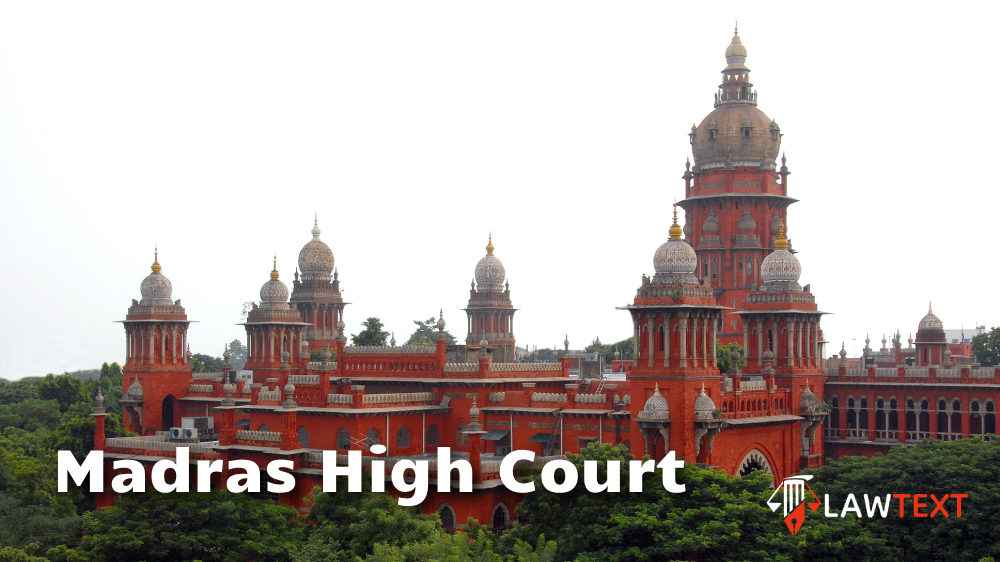
Case Note & Summary
The first plaintiff in a partition suit filed O.S. No.121 of 2010 before the Principal Sub Judge, Nagercoil, seeking partition and separate possession of four items of properties. The suit was decreed in part by the trial court on 28.02.2014. Both sides appealed to the Principal District Judge, Kanyakumari, who partly dismissed the appeal on 05.01.2019. The first plaintiff then filed a second appeal before the Madurai Bench of Madras High Court. The second appeal was admitted on 26.04.2019 on substantial questions of law regarding the proof of a Will (Ex.B8) dated 23.11.2000. The defendants claimed under the Will but did not examine any attesting witness. The appellant argued that the Will was not proved as required under Sections 68 and 69 of the Indian Evidence Act, 1872. The respondents contended that the Will was proved through other evidence. The High Court held that the courts below erred in accepting the Will without examining an attesting witness. The court set aside the concurrent findings and remanded the matter for fresh consideration, allowing the second appeal and the cross objection in part.
Headnote
A) Evidence Act - Will - Proof of Execution - Sections 68, 69 Indian Evidence Act, 1872 - The propounder of a Will must examine at least one attesting witness to prove its execution under Section 68. Section 69 applies only when all attesting witnesses are dead or not found. In this case, the defendants failed to examine any attesting witness, and the courts below erroneously held the Will as proved. Held that the Will (Ex.B8) is not proved in the manner required by law (Paras 3-10).
Issue of Consideration
Whether the courts below were correct in accepting the Will (Ex.B8) as proved when no attesting witness was examined, in violation of Sections 68 and 69 of the Indian Evidence Act, 1872.
Final Decision
The second appeal is allowed. The judgment and decree of the lower appellate court dated 05.01.2019 in A.S.No.29 of 2014 and the trial court decree dated 28.02.2014 in O.S.No.121 of 2010 are set aside. The matter is remanded to the trial court for fresh consideration in accordance with law. The cross objection is also allowed in part. No costs.
Law Points
- Will must be proved by examining at least one attesting witness under Section 68 of Indian Evidence Act
- 1872
- Section 69 applies only when attesting witnesses are dead or not found
- burden of proof of Will lies on propounder
- concurrent findings can be interfered with if perverse or based on no evidence.
Case Details
2026 LawText (MAD) (06) 187
Mr.V.Raghavachari, Senior Counsel assisted by Mr. TKS. Maniam for appellant; Mr.G.Prabhu Rajadurai for R2 and R3, Mr.V.Maharajan for R5
R.Muthammal, Kumaravel, P.Radhakrishnan, Jeyamma, C.Meyyappan
Subscribe to unlock Case Details (Citation, Judge, Date & more)
Subscribe Now
Nature of Litigation
Civil suit for partition and separate possession of properties.
Remedy Sought
Appellant sought to set aside the judgment and decree of the lower appellate court and to allow the partition suit as prayed.
Filing Reason
The appellant, as first plaintiff, claimed partition of four items of properties, but the courts below partly dismissed the suit based on a Will (Ex.B8) which was not proved in accordance with law.
Previous Decisions
Trial court decreed the suit in part on 28.02.2014; lower appellate court partly dismissed the appeal on 05.01.2019.
Issues
Whether the Will (Ex.B8) was proved in accordance with Sections 68 and 69 of the Indian Evidence Act, 1872, when no attesting witness was examined.
Whether the concurrent findings of the courts below are perverse and liable to be interfered with in second appeal.
Submissions/Arguments
Appellant argued that the defendants failed to examine any attesting witness to prove the Will, and the courts below erred in accepting the Will as proved.
Respondents contended that the Will was proved through other evidence and that the concurrent findings should not be disturbed.
Ratio Decidendi
A Will must be proved by examining at least one attesting witness under Section 68 of the Indian Evidence Act, 1872. Section 69 applies only when all attesting witnesses are dead or not found. Failure to examine any attesting witness renders the Will unproved, and concurrent findings based on such erroneous appreciation of evidence are perverse and liable to be set aside in second appeal.
Judgment Excerpts
When the defendants claiming under the Will marked as Ex.B8, dated 23.11.2000, had not examined any one of the attesting witnesses and in the absence of proving of the said Will in the manner required under Sections 68 and 69 of the Indian Evidence Act, 1872, whether the Courts below were correct in accepting the said Will as proved?
The propounder of a Will must examine at least one attesting witness to prove its execution under Section 68. Section 69 applies only when all attesting witnesses are dead or not found.
Procedural History
O.S.No.121 of 2010 filed before Principal Sub Judge, Nagercoil, decreed in part on 28.02.2014. A.S.No.29 of 2014 before Principal District Judge, Kanyakumari, partly dismissed on 05.01.2019. Second appeal filed before Madurai Bench of Madras High Court, admitted on 26.04.2019, and disposed on 17.07.2026.
Acts & Sections
- Indian Evidence Act, 1872: 68, 69
- Code of Civil Procedure, 1908: 100