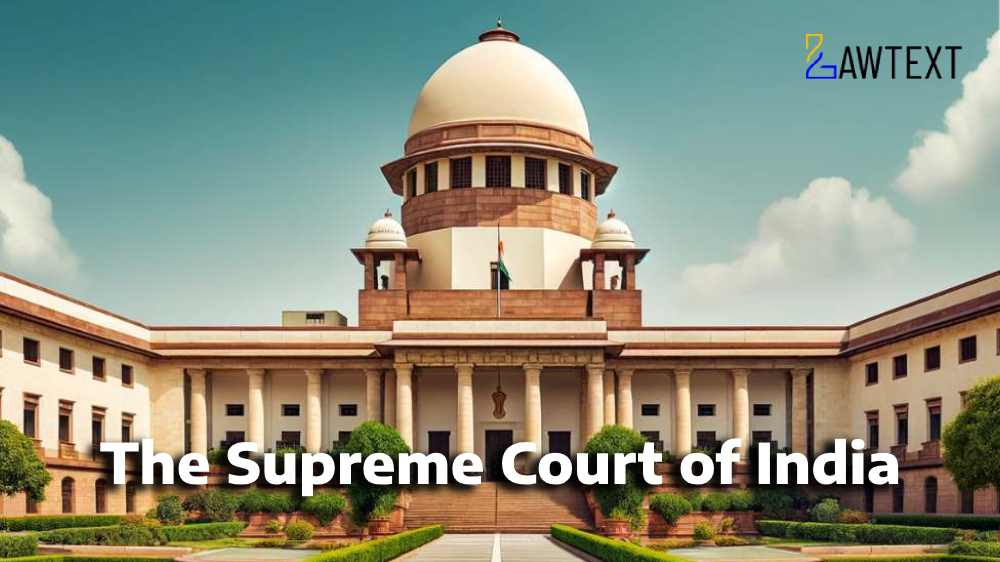
Case Note & Summary
The case involved writ petitions under Article 226 of the Constitution of India, filed before the Delhi High Court by landowners in village Nilothi, National Capital Territory of Delhi, challenging notifications dated January 6, 1995 and March 9, 1995 issued under Sections 4, 6 and 17(4) of the Land Acquisition Act, 1894. The land was being acquired for a public purpose, namely setting up of a pumping station/sewerage treatment plant in villages Jasola, Nilothi and Shaffipur Ranola for planned development of Delhi. The Lt. Governor of Delhi dispensed with the inquiry under Section 5-A by invoking urgency provisions under Section 17(1) and (4). These petitions were transferred to the Supreme Court because the Court was already monitoring construction of sewage treatment plants in Delhi in M.C. Mehta v. Union of India (Writ Petition (Civil) No. 4677 of 1985). The Supreme Court had issued time-bound directions for procurement of land and construction of STPs, and stay orders of the High Court were vacated. The petitioners contended that the expression 'likely to be needed' in the Section 4 notification indicated only a future requirement, thus no urgency existed and the right to file objections under Section 5-A could not be taken away. They also argued that the acquisition was contrary to the Master Plan and Zonal Development Plan as the land was shown as agricultural green. The Court held that Section 4 of the Act allows the Government to act when land 'is needed or is likely to be needed'. While 'is needed' shows an existing need and 'likely to be needed' refers to future need, urgency cannot be determined solely by the expressions used in the notification. The existence of urgency is a matter of subjective satisfaction of the Government, and courts do not interfere unless the reasons are wholly irrelevant and there is no application of mind. When a notification uses 'is likely to be needed', it may be necessary to examine the records or attendant circumstances to satisfy that there was material before the Government justifying the order under Section 17. If the public purpose on the face of it shows that the land is needed urgently, that by itself is a relevant circumstance for justifying the action under Section 17(4). The Court referred to State of U.P. v. Smt. Pista Devi, where housing accommodation was considered a matter of national urgency, and to its own directions in M.C. Mehta v. Union of India, which had repeatedly emphasized the urgency of constructing sewage treatment plants to control pollution and protect public health. The Court observed that treatment of sewage is of utmost importance for health and for supply of pure water to the citizens of Delhi, and any delay in this respect is a health hazard and cannot be tolerated. In light of these circumstances, the Court found that the urgency provision was validly invoked and the dispensation of the inquiry under Section 5-A was justified. The writ petitions were dismissed and the acquisition notifications were upheld.
Headnote
A) Land Acquisition - Urgency Clause - Section 17(4) of Land Acquisition Act, 1894 - Dispensing with Section 5-A inquiry - The existence of urgency is a matter of subjective satisfaction of the Government; courts do not interfere unless reasons are wholly irrelevant or there is no application of mind. The expression 'is likely to be needed' in a notification under Section 4 does not by itself negate urgency; the public purpose on the face of it, such as construction of a sewage treatment plant to prevent environmental pollution, can justify dispensing with Section 5-A. The Supreme Court found that time-bound directions in M.C. Mehta v. Union of India for the construction of sewage treatment plants established urgency; acquisition notifications were upheld; Held that the urgency provision was validly invoked. (Paras 1-5)
Issue of Consideration
Whether the notification under Section 4 of the Land Acquisition Act, 1894 using the expression 'likely to be needed' indicated no existing need and hence no urgency to invoke Section 17(4) and dispense with Section 5-A inquiry; whether the acquisition was contrary to the Master Plan and Zonal Development Plan
Final Decision
The Supreme Court upheld the notifications dated January 6, 1995 and March 9, 1995 under Sections 4, 6 and 17(4) of the Land Acquisition Act, 1894 and dismissed the writ petitions, holding that the urgency provision was validly invoked and Section 5-A dispensation was justified.
Law Points
- Existence of urgency under Section 17(4) of Land Acquisition Act
- 1894 is a matter of subjective satisfaction of the Government
- courts do not interfere unless reasons are wholly irrelevant or there is no application of mind
- expression 'is likely to be needed' in Section 4 notification does not by itself negate urgency
- public purpose on the face of it can justify dispensing with Section 5-A inquiry
- environmental protection and construction of sewage treatment plants constitute urgent public purpose
- time-bound directions of Supreme Court in M.C. Mehta case establish urgency