
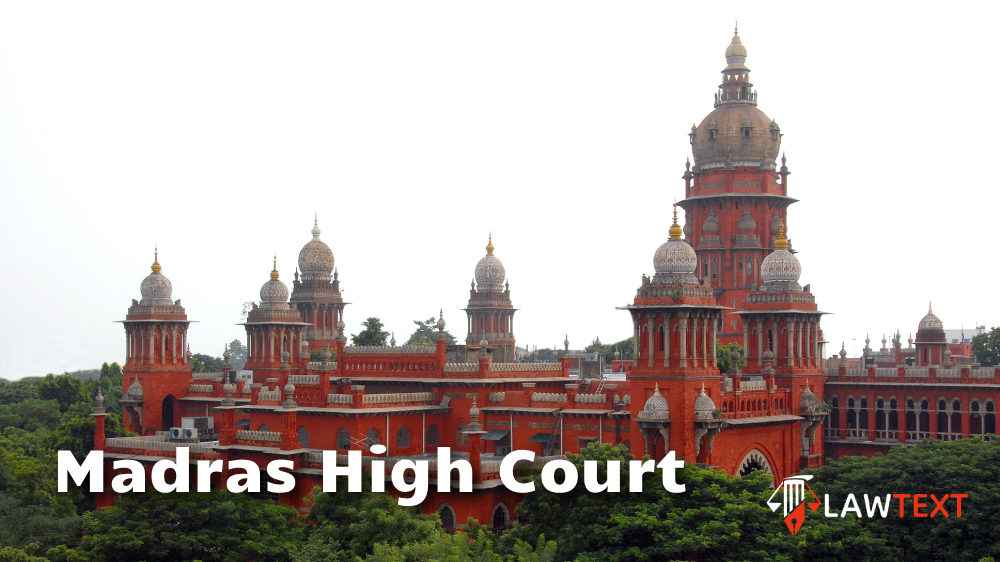
Madras High Court Dismisses Writ Petition Against National Consumer Commission's Order Upholding Revision Dismissal in Electricity Service Deficiency Case. The Court held that under Section 58(1)(b) of the Consumer Protection Act, 2019, the National Commission's power of revision is limited to jurisdictional errors or material irregularity, and judicial review under Article 226 does not permit re-appreciation of facts when two consumer fora have given concurrent findings.

High Court: Madras High Court Bench: Principal In Favour of Accused
  • 1
Judgement Image
Font size:
Print

Case Note & Summary

The proceedings arose from a consumer complaint filed by Dr. V. Murugan before the District Consumer Disputes Redressal Forum, Chengalpet, alleging deficiency in service on the part of the Tamil Nadu Electricity Board (now TANGEDCO) in relation to his electricity service connection. The complainant asserted that the Board's actions caused loss of crops and mental agony, claiming compensation of Rs.4,20,000 for three crop periods, Rs.50,000 for mental agony, and Rs.10,000 towards litigation expenses. The District Forum, after considering the matter, passed an order on 20.09.2017 partly allowing the complaint, directing the electricity officials to reconnect the service and awarding Rs.10,000 as compensation along with Rs.3,000 as costs. Dissatisfied with the quantum of relief, the complainant preferred a first appeal before the State Consumer Disputes Redressal Commission, Chennai. The State Commission, by its order in F.A.No.351 of 2017, enhanced the compensation to Rs.25,000 but otherwise confirmed the district forum's decision. Still aggrieved, the complainant approached the National Consumer Disputes Redressal Commission by way of Revision Petition No.1841 of 2023 under Section 58 of the Consumer Protection Act, 2019. The National Commission, relying on the Supreme Court's decision in Rubi Chandra Dutta v. United India Insurance Co. Ltd., held that its revisional power is limited to examining jurisdictional errors or material irregularity, and finding neither, dismissed the revision petition on 23.08.2023. The complainant then invoked the writ jurisdiction of the Madras High Court under Article 226 of the Constitution, seeking certiorari to quash the National Commission's order and mandamus directing payment of the originally claimed compensation amounts. Before the High Court, the petitioner contended that the National Commission had failed to appreciate the factual grounds raised, thereby warranting interference. The respondent electricity board defended the orders of the consumer fora. The core legal issue was the scope of the National Commission's revisional power under Section 58(1)(b) of the Consumer Protection Act, 2019, and the extent of the High Court's power of judicial review over such orders. The High Court examined Section 58(1)(b) which stipulates that the National Commission may intervene only where the State Commission has exercised a jurisdiction not vested in it, failed to exercise a vested jurisdiction, or acted illegally or with material irregularity. The Court noted that both the District Forum and the State Commission had thoroughly adjudicated the facts and delivered well-reasoned orders. Consequently, the National Commission's finding that there was no infirmity or jurisdictional error was in strict conformity with the statutory provision. The Court held that the petitioner's argument that the National Commission should have re-appreciated facts was without merit, as the revisionary power does not permit a re-trial of factual issues. Turning to its own jurisdiction under Article 226, the High Court emphasized that judicial review is directed at the decision-making process, not the correctness of the decision. Since the two consumer fora had already examined the facts in detail, further adjudication was neither necessary nor permissible. The Court concluded that the National Commission's order was legally sound and suffered from no error. Accordingly, the writ petition was dismissed without costs. The judgment reaffirmed the limited scope of revision under the Consumer Protection Act and the supervisory nature of writ jurisdiction, ensuring that concurrent factual findings by specialized tribunals are not lightly disturbed.

Headnote

A) Consumer Law - Revisionary Jurisdiction - Scope of Revision under Section 58(1)(b) of Consumer Protection Act, 2019 - The National Commission can intervene only if the State Commission exercised jurisdiction not vested, failed to exercise vested jurisdiction, or acted illegally or with material irregularity - The District and State Commissions had given well-reasoned orders on facts, and the National Commission found no jurisdictional error or material irregularity, dismissing the revision petition - Held that the National Commission's order was in consonance with Section 58(1)(b) (Paras 4-8).

B) Constitutional Law - Writ Jurisdiction - Scope of Judicial Review under Article 226 of the Constitution of India - High Court's power under Article 226 is supervisory, ensuring the decision-making process follows statutes and rules, not to re-examine factual findings - Since two consumer fora had elaborately adjudicated facts, the High Court declined to interfere, finding no infirmity in the National Commission's order - Held that the writ petition was liable to be dismissed (Paras 9-10).

Subscribe to unlock Headnote Subscribe Now

Issue of Consideration

Whether the National Consumer Disputes Redressal Commission's order dismissing the revision petition was in accordance with Section 58(1)(b) of the Consumer Protection Act, 2019, and whether the High Court under Article 226 could interfere with the concurrent factual findings of the District and State Consumer Fora.

Subscribe to unlock Issue of Consideration Subscribe Now

Final Decision

The writ petition was dismissed without costs. The Court held that the National Commission's revisionary power under Section 58(1)(b) of the Consumer Protection Act, 2019, is limited to jurisdictional errors or material irregularity, and that judicial review under Article 226 is confined to ensuring the decision-making process was followed, not to re-appreciate facts. The concurrent factual findings by the District and State Commissions were affirmed.

Law Points

  • Legal points not extracted
  • Scope of revision under Section 58(1)(b) of Consumer Protection Act
  • 2019
  • limited to jurisdictional errors or material irregularity
  • Judicial review under Article 226 of the Constitution of India is to ensure process
  • not to re-appreciate facts
  • National Commission correctly applied its limited revisional power

Subscribe to unlock Law Points Subscribe Now

Case Details

2025 LawText (MAD) (03) 74

W.P.No.1126 of 2024

2025-03-20

S.M. Subramaniam, K. Rajasekar

Citation not available, 2025:MHC:777

S. Sairam, L.J. Krishnamurthy, Sindhuza M.S., L. Jaivenkatesh

Dr. V. Murugan

1. The Chairman, T.N.E.B., Mount Road, Chennai 600 002; 2. The Executive Engineer (O & M), T.N.E.B., Porur, Chennai 600 116; 3. The Assistant Executive Engineer, T.N.E.B., Thirumudivakkam, Chennai 600 132; 4. The Assistant Engineer, T.N.E.B., Thirumudivakkam, Chennai 600 132

Subscribe to unlock Case Details (Citation, Judge, Date & more) Subscribe Now

Nature of Litigation

Writ petition under Article 226 of the Constitution of India challenging an order of the National Consumer Disputes Redressal Commission and seeking enhanced compensation for alleged deficiency in service by the Tamil Nadu Electricity Board.

Remedy Sought

The petitioner sought to quash the National Commission's order and prayed for a direction to the respondents to pay compensation of Rs.4,20,000 for crop loss, Rs.50,000 for mental agony, and Rs.10,000 for litigation costs.

Filing Reason

The petitioner was aggrieved by the National Commission's dismissal of his revision petition, which upheld the State Commission's enhancement of compensation to only Rs.25,000, whereas he claimed much higher damages.

Previous Decisions

The District Consumer Disputes Redressal Forum, Chengalpet, in C.C.No.81 of 2015 partly allowed the complaint, awarding Rs.10,000 compensation and Rs.3,000 costs. The State Consumer Disputes Redressal Commission, Chennai, in F.A.No.351 of 2017 enhanced compensation to Rs.25,000 and confirmed the rest. The National Consumer Disputes Redressal Commission, in Revision Petition No.1841 of 2023, dismissed the revision petition finding no infirmity.

Issues

Whether the National Consumer Disputes Redressal Commission had exceeded its revisional jurisdiction under Section 58(1)(b) of the Consumer Protection Act, 2019, by dismissing the revision petition. Whether the High Court under Article 226 of the Constitution of India should interfere with the concurrent findings of fact by the District and State Consumer Fora.

Submissions/Arguments

The petitioner argued that the National Commission failed to properly appreciate the factual grounds raised, and thus the writ court should examine the matter afresh.

Ratio Decidendi

The National Commission's revisional jurisdiction under Section 58(1)(b) of the Consumer Protection Act, 2019, is limited to cases where the State Commission has exercised a jurisdiction not vested, failed to exercise vested jurisdiction, or acted illegally or with material irregularity. When two consumer fora have given well-reasoned orders on facts, the National Commission cannot re-appreciate evidence. Further, the High Court's power under Article 226 of the Constitution is supervisory, ensuring that the decision-making process is in accordance with law, and does not extend to substituting its own view on facts. Thus, concurrent findings of fact by consumer fora are not to be disturbed in writ jurisdiction absent jurisdictional error.

Judgment Excerpts

When the scope of revision petition has been expressly stipulated under Section 58(1)(b) of the Consumer Protection Act, the grounds raised by the writ petitioner before this Court that the National Commission has erred in not appreciating the facts, deserves no merit consideration. The power of judicial review of the High Court under Article 226 of the Constitution of India is to ensure the processes through which the decision has been taken by the competent authorities/forum in consonance with the statutes and rules in force, but not the decision itself. Thus we do not find any infirmity in respect of the order impugned passed by the National Consumer Disputes Redressal Commission, which is in consonance with Section 58(1)(b) of the Consumer Protection Act.

Procedural History

The petitioner filed a complaint before the District Consumer Disputes Redressal Forum, Chengalpet, in C.C.No.81 of 2015 alleging deficiency in service by T.N.E.B. The District Forum partly allowed the complaint on 20.09.2017, directing reconnection and awarding compensation of Rs.10,000 plus costs. The petitioner appealed to the State Consumer Disputes Redressal Commission, Chennai, in F.A.No.351 of 2017; the State Commission enhanced compensation to Rs.25,000 and confirmed the rest. The petitioner then filed Revision Petition No.1841 of 2023 before the National Consumer Disputes Redressal Commission, New Delhi, which dismissed the revision on 23.08.2023, finding no infirmity. The petitioner subsequently filed W.P.No.1126 of 2024 before the High Court under Article 226, seeking to quash the National Commission's order and claim enhanced compensation. The High Court dismissed the writ petition on 20.03.2025.

Acts & Sections

  • Consumer Protection Act, 2019: 58(1)(b)
  • Constitution of India: 226
Subscribe to unlock full Legal Analysis Subscribe Now
Related Judgement
Supreme Court Supreme Court Allows Appeal of Mining Company in Industrial Disputes Act Matter Due to Exemption of Entire Mining Industry. Notification Exempting 'Mines' Industry Under Section 1(3) of Central Provinces and Berar Industrial Disputes Settlement Act, ...
Related Judgement
High Court Madras High Court Dismisses Writ Petition Against National Consumer Commission's Order Upholding Revision Dismissal in Electricity Service Deficiency Case. The Court held that under Section 58(1)(b) of the Consumer Protection Act, 2019, the National ...






