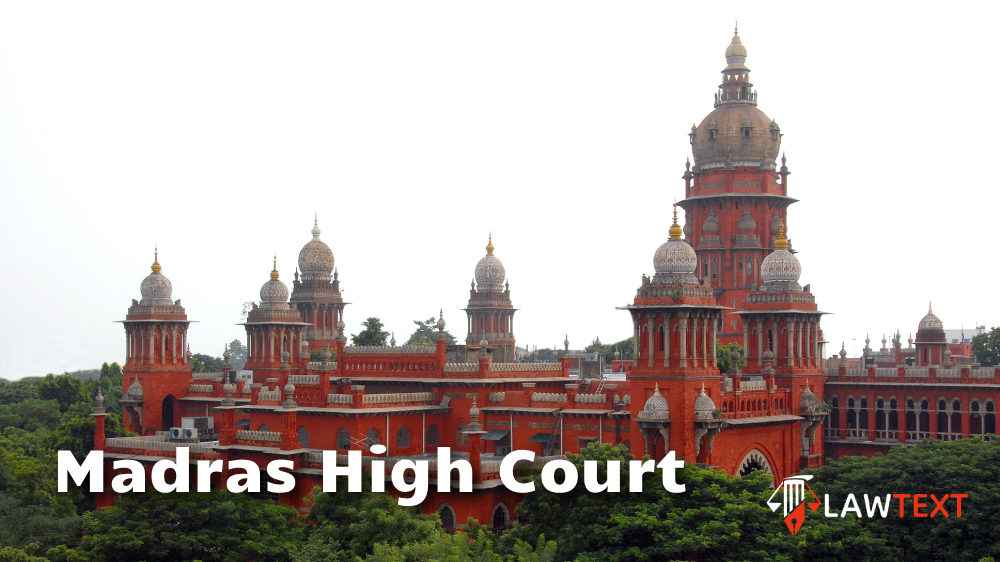
Madras High Court Partially Allows Journalists' Plea Against Alleged Harassment by Special Investigation Team in Cyber Crime Case. The Court directed that reporters cannot be summoned frequently without specific reason and their electronic devices cannot be seized without following due process under BNSS, emphasizing the right to privacy and protection of journalistic sources as laid down in Manohar Lal Sharma v. Union of India.

High Court: Madras High Court Bench: Principal In Favour of Accused
  • 2
Judgement Image
Font size:
Print

Case Note & Summary

The case arose from writ petitions filed by various reporters of news channels and a criminal original petition seeking directions to restrain the Special Investigation Team (SIT) from harassing them in the guise of an enquiry connected to Crime No. 107 of 2024. The background involved the alleged sexual assault of a second-year engineering student at Anna University on 23.12.2024, which led to the registration of FIR in Crime No. 3 of 2024 for offences under Sections 63(a), 64(1), 75(i)(ii) of the Bharatiya Nyaya Sanhita, 2023. The FIR was uploaded on the Tamil Nadu police's CCTNS portal, revealing the victim's identity. This prompted public interest litigation, and a Division Bench of the Madras High Court, by order dated 28.12.2024, constituted an all-women SIT to investigate both the sexual assault case and the FIR leak case (Crime No. 107 of 2024 under Section 72 BNS and Section 67A of the IT Act) and issued multiple directions. The State Government appealed to the Supreme Court, which on 27.01.2025 stayed certain portions, but the SIT continued its probe. The SIT issued summons to the petitioners, who are journalists, under Sections 179 and 94 BNSS, directing them to appear with their devices. The petitioners were summoned repeatedly on 29.01.2025, 31.01.2025, and 05.02.2025, and they alleged that the questioning was irrelevant, their mobile phones were seized without following due process, and they were threatened. They contended that they had no role in uploading the FIR; rather, it was the police who uploaded it. The petitioners argued that the SIT's actions violated their fundamental rights under Articles 19(1)(a), 20(3), and 21 of the Constitution, as well as Section 15(2) of the Press Council Act, which protects journalistic sources. They relied on the Supreme Court's decision in Manohar Lal Sharma v. Union of India (2023) 11 SCC 401, which underscored the need to protect journalistic sources. The respondents, represented by the Government Advocate, defended the investigation but did not justify the alleged harassment. The court analyzed that while the SIT was constituted to investigate serious offences, it could not act in a manner that harasses individuals, especially journalists who were not accused. The repeated summoning without specific reasons and the seizure of devices without adhering to the procedure under BNSS were found to be excessive. The court held that the right to privacy and freedom of press must be respected, and any investigation must follow due process. It directed that the SIT shall not summon the petitioners frequently without reason, and if device possession is required, procedure under BNSS must be followed. The SIT was allowed to proceed if material indicating the petitioners' involvement was found, and the principles from Manohar Lal Sharma were to be adhered to. The writ petitions were disposed of accordingly with no costs.

Headnote

A) Constitution Law - Freedom of Press - Article 19(1)(a) Constitution of India - Journalists summoned repeatedly by SIT in cyber crime case - Petitioners, reporters, were not connected to uploading of FIR; FIR was uploaded by police on CCTNS portal - Held that SIT cannot harass journalists in the guise of investigation; frequent summoning and irrelevant questioning violates freedom of press (Paras 3-8).

B) Criminal Procedure - Investigation Powers - Sections 179 and 94 BNSS - Seizure of electronic devices - SIT seized mobile phones without following due process; direction given that if devices are required, procedure under BNSS must be followed and devices shall not be seized without proper justification (Paras 9-10).

C) Evidence - Privilege of Journalists - Section 15(2) Press Council Act, Article 20(3) Constitution - Disclosure of sources - Petitioners argued they cannot be compelled to disclose sources; relying on Manohar Lal Sharma v. Union of India (2023) 11 SCC 401, court reiterated that protection of journalistic sources is a basic condition for freedom of press; SIT cannot compel disclosure of sources without following law (Paras 8.4, 8.5, 10).

D) Criminal Investigation - Cyber Crime - Section 72 BNS, Section 67A IT Act - Leaking of FIR in sensitive sexual offence case - The SIT was constituted to investigate the uploading of FIR revealing victim's identity; court directed SIT to pursue investigation but ensuring that reporters are not unnecessarily harassed; if material found, appropriate action can be taken (Paras 5, 7, 10).

Subscribe to unlock Headnote Subscribe Now

Issue of Consideration

Whether the Special Investigation Team’s repeated summoning and seizure of devices of journalists without following due process amounts to harassment and is violative of fundamental rights under Articles 19(1)(a), 20(3) and 21 of the Constitution of India, and whether journalists can be compelled to disclose their sources.

Subscribe to unlock Issue of Consideration Subscribe Now

Final Decision

In view of the above, all these writ petitions stand disposed of with the following directions: (i) The third respondent / Special Investigation Team is directed not to summon the petitioners frequently without any specific reason, except following due process of law; (ii) If the possession of the devices is required, the third respondent shall follow the procedure as contemplated under Bharatiya Nagarik Suraksha Sanhita, 2023 and the devices shall not be seized without following due process; (iii) On perusal of the seized devises, if any material indicated for the involvement of the petitioners in the crime as alleged, the third respondent is at liberty to proceed further in accordance with law; (iv) If any material is indicated from the seized devises, the third respondent may call for further details from the respective petitioners and the petitioners shall co-operate for enquiry; (v) The principles laid down by the Hon'ble Supreme Court of India in Manohar Lal Sharma Vs. Union of India reported in 2023 (11) SCC 401 shall be followed in respect of the petitioners. With the above directions, all these writ petitions are disposed of. Consequently, connected Miscellaneous Petitions are closed. There shall be no order as to costs.

Law Points

  • Legal points not extracted
  • freedom of speech and expression
  • right to privacy
  • right against self-incrimination
  • protection of journalistic sources
  • harassment by investigation agency
  • due process under BNSS
  • Article 19(1)(a)
  • Article 20(3)
  • Article 21
  • Section 15(2) Press Council Act
  • 1978
  • Section 179 and 94 BNSS
  • Section 72 BNS
  • Section 67A IT Act
  • Manohar Lal Sharma v. Union of India

Subscribe to unlock Law Points Subscribe Now

Case Details

2025 LawText (MAD) (02) 156

W.P. Nos. 3950, 3968, 4048 & 4107 of 2025 and Crl. O.P. No. 2937 of 2025

2025-02-04

G.K. Ilanthiraiyan

Citation not available, 2025:MHC:320

M.R. Jothimanian, K. Balu, K. Elangovan, C. Arun Kumar, R. Vivekananthan for petitioners; K.M.D. Muhilan for respondents

M. Saravana Kumar & Ors.

State of Tamil Nadu & Ors.

Subscribe to unlock Case Details (Citation, Judge, Date & more) Subscribe Now

Nature of Litigation

Writ petitions under Article 226 of the Constitution of India seeking a writ of mandamus to forbear the Special Investigation Team from harassing the petitioners in the guise of enquiry.

Remedy Sought

Direction to the SIT not to harass the petitioners without following due process of law.

Filing Reason

The petitioners, who are reporters for various news channels, were repeatedly summoned by the SIT in connection with Crime No.107 of 2024, alleging that they were being asked irrelevant questions, their devices were seized without proper procedure, and they were threatened, thereby violating their fundamental rights.

Previous Decisions

The Hon'ble Division Bench of the Madras High Court, by order dated 28.12.2024 in W.P.Nos.39893 & 39895 of 2024, constituted an all-women Special Investigation Team to investigate the sexual assault case (Crime No.3/2024) and the FIR leak case (Crime No.107/2024) and issued several directions. Subsequently, the Hon'ble Supreme Court, by order dated 27.01.2025 in S.L.P.Nos.1027 & 1028 of 2025, stayed certain portions of that order but the constitution of SIT and investigation continued.

Issues

Whether the SIT’s conduct of repeatedly summoning journalists and seizing their devices without due process amounts to harassment and violates their fundamental rights under Articles 19(1)(a), 20(3) and 21 of the Constitution. Whether the SIT can compel journalists to disclose their sources in violation of Section 15(2) of the Press Council Act and the principles laid down in Manohar Lal Sharma v. Union of India. Whether the investigation should be interfered with and directions issued to ensure due process.

Submissions/Arguments

Petitioners, being reporters, had no role in uploading the FIR; it was uploaded by police on CCTNS portal. Repeated summoning on consecutive dates and asking personal, irrelevant questions amounted to harassment. Seizure of mobile phones and other devices without following the procedure under BNSS violated their right to privacy and against self-incrimination. Compelling disclosure of journalistic sources contravened Section 15(2) of the Press Council Act and the Supreme Court’s ruling in Manohar Lal Sharma. The SIT’s actions were an attack on press freedom and meant to stifle criticism of the police investigation.

Ratio Decidendi

The investigating agency cannot harass journalists in the guise of enquiry. Frequent summoning without specific reason and seizure of devices without following the due process under BNSS is impermissible. Journalists have the right to privacy and protection of sources under Article 19(1)(a), 20(3) and 21 of the Constitution and Section 15(2) of the Press Council Act. The investigation must be conducted in accordance with law, respecting the fundamental rights of individuals, especially when they are not accused but merely witnesses or persons acquainted with facts. Any action must be proportional and not amount to harassment.

Judgment Excerpts

On 23.12.2024, within the campus of Anna University situated at Guindy, Chennai, a second year engineering student was allegedly sexually assaulted by the accused. the FIR was uploaded in the public domain of Tamil Nadu police website called Crime and Criminal Tracking Network and Systems (hereinafter referred to as “CCTNS”). After uploading in the public domain, it was downloaded by various persons from the public domain thereby the identity of the victim was revealed and breached her right to privacy. The Hon'ble Supreme Court of India in Manohar Lal Sharma Vs. Union of India held: 'An important and necessary corollary of such a right is to ensure the protection of sources of information. Protection of journalistic sources is one of the basic conditions for the freedom of the press.' In view of the above, all these writ petitions stand disposed of with the following directions:

Procedural History

Registration of FIR in Crime No.3/2024 on 23.12.2024 for sexual assault at Anna University. Registration of FIR in Crime No.107/2024 under Section 72 BNS and 67A IT Act for uploading the FIR. Division Bench order dated 28.12.2024 in PILs constituting SIT and issuing directions. Supreme Court order dated 27.01.2025 staying parts of that order. On 28.01.2025, SIT directed petitioners to appear on 29.01.2025. Petitioners appeared and were again summoned for 31.01.2025, and again for 05.02.2025. The present writ petitions were filed in 2025. Court heard and disposed on 04.02.2025.

Acts & Sections

  • Bharatiya Nyaya Sanhita, 2023: 63(a), 64(1), 75(i)(ii), 72
  • Bharatiya Nagarik Suraksha Sanhita, 2023: 179, 94
  • Information Technology Act, 2000: 67A
  • Constitution of India: Article 19(1)(a), 20(3), 21, 226
  • Press Council Act, 1978: 15(2)
Subscribe to unlock full Legal Analysis Subscribe Now
Related Judgement
High Court Madras High Court Partially Allows Journalists' Plea Against Alleged Harassment by Special Investigation Team in Cyber Crime Case. The Court directed that reporters cannot be summoned frequently without specific reason and their electronic devices ca...
Related Judgement
Supreme Court Supreme Court Refers to Larger Bench the Question of Quashing Non-Compoundable Offences Under Section 482 CrPC Based on Settlement, Reconsidering B.S. Joshi, Nikhil Merchant, and Manoj Sharma. The Court Doubts Whether Non-Compoundable Offences Can Be...