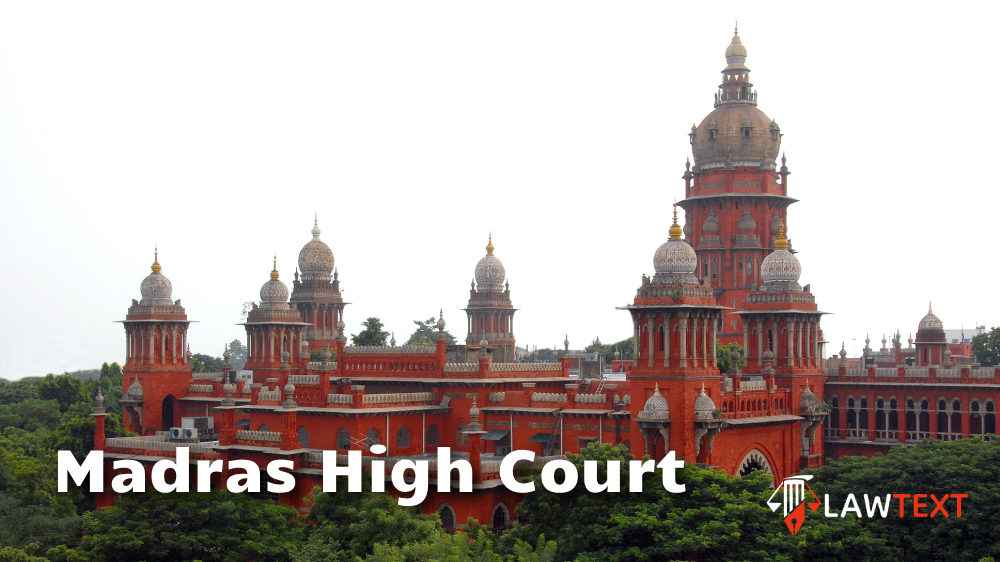
Case Note & Summary
The petitioner, a private company, filed C.S.(Comm.Div.) No.199 of 2023 before the Madras High Court against several parties including the 5th respondent, seeking remedies for alleged infringement of trademark and passing off. The petitioner also filed two rectification petitions (Nos. 272370 and 272372) before the Registrar of Trade Marks, Ahmedabad, under the Trade Marks Act, 1999, challenging registration of trademarks in classes 27 and 35. The petitioner requested the Registrar to transfer those rectification petitions to the Intellectual Property Division (IPD) of the Madras High Court under Section 125(2) of the Act, contending that consolidation of proceedings would enable expeditious disposal. Upon receiving no response, the petitioner invoked Article 226 of the Constitution seeking a writ of mandamus directing the Union and Trade Marks authorities to effect the transfer. The principal legal issue was whether the Madras High Court could direct such transfer and whether it possessed jurisdiction under Sections 47 and 57 of the Trade Marks Act to adjudicate rectification petitions concerning trademarks registered by the Ahmedabad office. Petitioner argued that cause of action arose within the jurisdiction, and that Rule 14(1) of the Madras High Court Intellectual Property Division Rules, 2023 permitted consolidation. The 5th respondent contended that the appropriate High Court was the Gujarat High Court and that the writ petition was not maintainable. The court examined the scheme of the Trade Marks Act, emphasizing the repeated use of the definite article 'the' before 'High Court' in Sections 47, 57, 91, 124, and 125, and contrasted it with the indefinite article 'a' in Section 2(1)(s). It held that Parliament intended to confer statutory rectification jurisdiction only on the High Court with appellate authority over the concerned Registrar. Rule 4 of the Trade Marks Rules, 2017, which defines the appropriate office by reference to the registered proprietor's principal place of business, confirmed that the Ahmedabad Registry was the correct forum. The court distinguished its earlier decision in Adiuvo Diagnostics by noting that the present case concerned statutory jurisdiction under the Trade Marks Act, not merely location of the authority. It observed that allowing transfer would lead to jurisdictional chaos, as any 'person aggrieved' could file rectification petitions in multiple High Courts. The court also held that Rule 14 of the MHC IPD Rules could not be invoked because it only covered proceedings within the court's own supervisory jurisdiction, not those of other High Courts. Accordingly, the writ petitions were dismissed, and the court declined to issue any direction for transfer, concluding that the proper remedy lay with the Gujarat High Court.
Headnote
A) Trade Marks - Rectification Jurisdiction - Sections 47 and 57 Trade Marks Act, 1999 - The definite article 'the' before 'High Court' indicates that jurisdiction is vested in a specific High Court, namely the one exercising appellate jurisdiction over the Trade Marks Registry that made the entry - Held that rectification petitions filed against trademarks registered by the Ahmedabad office lie before the Gujarat High Court, not any High Court where a suit is pending (Paras 10-14) B) Trade Marks - Transfer of Rectification Petitions - Article 226 Constitution of India - High Court cannot use writ jurisdiction to transfer rectification petitions if it lacks statutory jurisdiction under the Trade Marks Act - Held that a writ of mandamus cannot be issued to direct transfer where the court has no authority to decide the rectification petition itself (Paras 14-16) C) Trade Marks - Appropriate Office - Rule 4 Trade Marks Rules, 2017 - Rectification application must be filed before the appropriate office based on the principal place of business of the registered proprietor as per the register - Held that since the registered proprietor's principal place is in Surat, Gujarat, the appropriate office is Ahmedabad, and the rectification petitions were rightly filed there (Paras 12-13) D) Intellectual Property Division Rules - Consolidation of Proceedings - Rule 14(1) Madras High Court Intellectual Property Division Rules, 2023 - Rule 14 permits consolidation only of proceedings over which the court exercises supervisory jurisdiction - Held that rectification petitions pending before the Registrar at Ahmedabad are not within the supervisory jurisdiction of this Court, so consolidation cannot be ordered under Rule 14 (Para 15)
Issue of Consideration
Whether the High Court of Madras has jurisdiction to direct transfer of rectification petitions pending before Registrar of Trade Marks, Ahmedabad, and whether it can exercise powers under Sections 47 and 57 of the Trade Marks Act, 1999 for trade marks registered by the Ahmedabad office.
Final Decision
Writ petitions dismissed. The court held that it lacked statutory jurisdiction under the Trade Marks Act to entertain or transfer rectification petitions for trademarks registered by the Ahmedabad office. The prayer for mandamus was rejected, and the court concluded that the proper High Court was the one exercising appellate jurisdiction over the relevant Trade Marks Registry, i.e., the Gujarat High Court.
Law Points
- Legal points not extracted
- interpretation of 'the High Court' in Trade Marks Act
- 1999
- jurisdiction for rectification under Sections 47 and 57
- appropriate office under Rule 4 of Trade Marks Rules
- 2017
- Article 226 cannot confer statutory jurisdiction
- consolidation limited to supervisory jurisdiction
- Tribunals Reforms Act
- 2021 amendment