
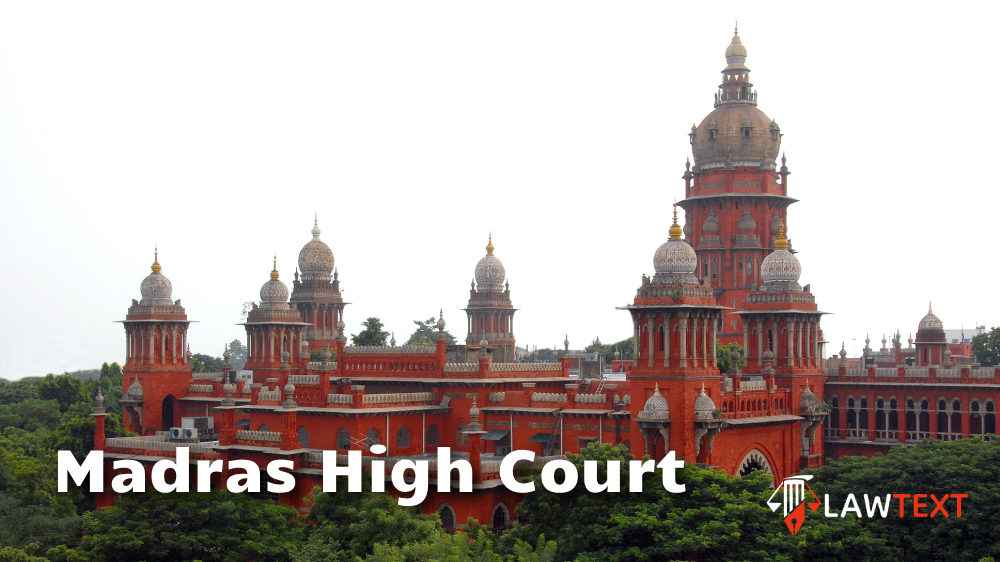
High Court of Madras Partly Allows Writ Petition Challenging Recovery of Excess Pay; Recovery Set Aside but Pay Revision Upheld. Court Applies Principles from State of Punjab v. Rafiq Masih, Holding Recovery Impermissible When Employee Belongs to Group C Service and No Misrepresentation, While Confirming Audit-Based Pay Revision.

High Court: Madras High Court Bench: Principal
  • 6
Judgement Image
Font size:
Print

Case Note & Summary

The writ petition was filed under Article 226 of the Constitution of India by Sivasakthi, a Computer Operator working at the Principal District Court, Dharmapuri, against the State of Tamil Nadu and judicial authorities. She challenged an order dated 28.11.2022 which sought to recover Rs.1,23,589 as excess pay and allowances on the ground that annual increments sanctioned for the period 07/2017 to 2019 were inadmissible following an internal audit objection. The petitioner also prayed for regularisation of her services from the date of appointment with all consequential benefits. The petitioner was appointed on 01.09.2015 and became an approved probationer on 10.01.2018. The impugned recovery was ordered after pay revision based on the audit report. The court noted that while unjust enrichment of public money is not permissible and the authorities can rectify pay fixation errors, the respondents could not prove any misrepresentation or fraud on the part of the petitioner. The error had been committed by the Establishment itself, and recovering the amount after several years would cause extreme hardship. Relying on the Supreme Court decision in State of Punjab v. Rafiq Masih, which held that recovery from Group C and D employees in such circumstances is impermissible, the court confirmed the pay revision but set aside only the recovery direction. Any amount already recovered was ordered to be refunded within twelve weeks. The writ petition was thus partly allowed.

Headnote

A) Service Law - Recovery of excess pay erroneously paid by employer - When recovery would cause extreme hardship and there is no misrepresentation by employee, it is impermissible - Constitution of India, 1950, Article 226 - Petitioner, a Computer Operator (Group

C) at District Court, was subjected to pay revision and recovery of Rs.1,23,589 due to audit objection that annual increments for 2017-2019 were inadmissible. The respondents failed to establish any misrepresentation by the petitioner, and the error was committed by the Establishment. The court, applying principles from State of Punjab v. Rafiq Masih, (2015) 4 SCC 334, held that recovery after several years would be iniquitous and harsh, and therefore set aside the recovery portion of the impugned order. (Paras 2-6)

B) Service Law - Pay revision based on audit objection - Employer has the right to rectify erroneous pay fixation and recover unjust enrichment - Constitution of India, 1950, Article 226 - The court held that unjust gain of public money is impermissible and the competent authority is empowered to correct pay fixation errors. Consequently, the revised pay fixation as per audit objection was confirmed, but the direction to recover excess pay was quashed. (Paras 3, 6)

Subscribe to unlock Headnote Subscribe Now

Issue of Consideration

Whether the respondent No.3's order dated 28.11.2022 for recovery of excess pay of Rs.1,23,589 from the petitioner, a Group C employee, is valid when no misrepresentation by the employee is established and the recovery is after a long period, and whether the services of the petitioner should be regularised.

Subscribe to unlock Issue of Consideration Subscribe Now

Final Decision

The Court partly allowed the writ petition, confirming the pay revision but setting aside the recovery of excess pay. Impugned order was set aside only with respect to recovery. Any excess amount already recovered must be repaid within 12 weeks.

Law Points

  • Legal points not extracted
  • recovery of excess pay impermissible if employee belongs to Group C/D
  • no misrepresentation
  • recovery after five years causes hardship
  • State of Punjab v. Rafiq Masih
  • pay revision upheld
  • audit objection
  • unjust gain of public money
Subscribe to unlock Law Points Subscribe Now

Case Details

2026 LawText (MAD) (07) 107

W.P. No. 38211 of 2025

2026-07-08

S.M. Subramaniam, N. Senthilkumar

Citation not available

G.RM.Palaniappan, R.Gouri, R.Sunil Kumar

Sivasakthi

1. The Principal Secretary, Government of Tamil Nadu, Home (Courts) Department; 2. The Registrar General, High Court of Madras; 3. The Principal District Judge, Principal District Court, Dharmapuri

Subscribe to unlock Case Details (Citation, Judge, Date & more) Subscribe Now

Nature of Litigation

Writ petition under Article 226 of the Constitution of India seeking certiorarified mandamus to quash an order for recovery of excess pay and to regularize services.

Remedy Sought

Petitioner sought quashing of order dated 28.11.2022 and direction to regularize services with all monetary benefits including maternity benefits.

Filing Reason

Petitioner was aggrieved by recovery of Rs.1,23,589 as excess pay and allowances based on audit objection that annual increments from 07/2017 to 2019 were inadmissible.

Previous Decisions

Previous decisions not referenced

Issues

Whether the recovery of excess pay from the petitioner who belongs to Group C service, without any misrepresentation on her part and after a period of several years, is permissible under law? Whether the pay revision based on audit objection is valid?

Submissions/Arguments

Petitioner contended that recovery was impermissible as there was no misrepresentation and it would cause hardship; she also sought regularisation from date of appointment. Respondents contended that audit objection revealed erroneous increment sanction and excess pay must be recovered.

Ratio Decidendi

Recovery of excess pay from a Group C employee where there was no misrepresentation by the employee and the error was committed by the employer, and when the recovery is sought after a period of more than five years, is impermissible as it would be iniquitous and harsh, following State of Punjab v. Rafiq Masih.

Judgment Excerpts

Unjust gain of public money is impermissible under law. In such circumstances, the Authorities Competent are empowered to rectify the errors in fixation of pay and grant the correct pay as applicable. However, the respondents are unable to establish that there was a misrepresentation on the part of the employee during fixation of pay. It is an error committed by the Establishment for which the petitioner cannot be penalised after a lapse of many years.

Procedural History

The petitioner filed the present writ petition directly before the High Court; no previous litigation is mentioned.

Acts & Sections

  • Constitution of India, 1950: Article 226
Subscribe to unlock full Legal Analysis Subscribe Now
Related Judgement
High Court Bombay High Court Quashes Default Sentence in DV Act Maintenance Case — Sentencing Without Prior Notice Violates Natural Justice. Imprisonment for non-payment of interim maintenance under Section 125(3) CrPC read with Section 28 DV Act requires pri...
Related Judgement
High Court Bombay High Court Quashes NDPS Prosecution for Lack of Sanction Under Section 36A(2) of NDPS Act — Cognizance by Special Court Without Valid Sanction Held Illegal. The court held that the mandatory requirement of previous sanction under Section 36A...







