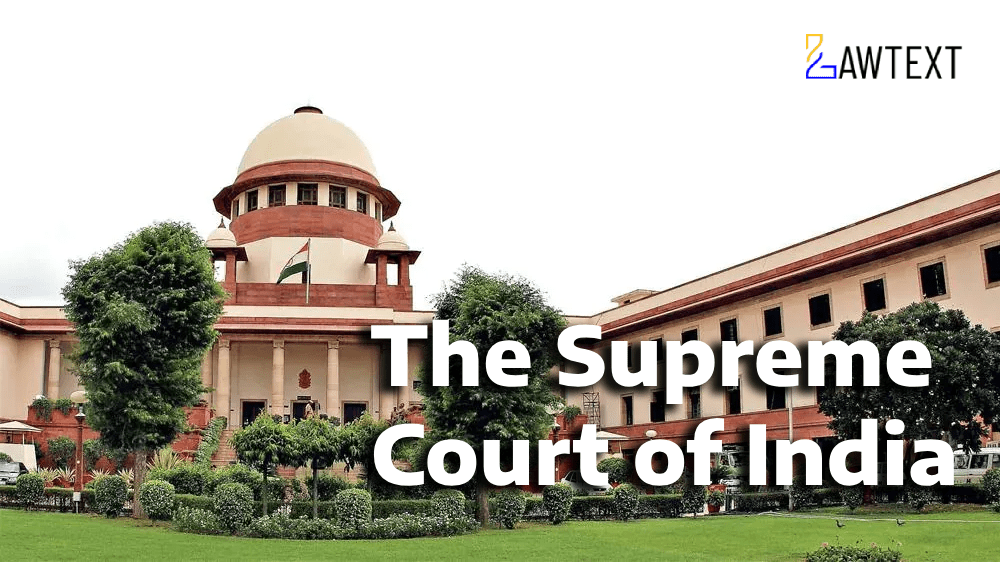
Case Note & Summary
The Supreme Court of India adjudicated an appeal concerning the right of a beneficiary to be impleaded as a party in pending proceedings before the Subordinate Judge, Angul. The appellant, a company, was the beneficiary in proceedings where the first respondent was a claimant. Leave to appeal was granted by the Supreme Court. Despite notice being served on the respondents, no one appeared for the first respondent-claimant. The core legal issue before the Court was whether the appellant, as a beneficiary, was entitled to be impleaded as a party in the pending proceedings. The Court observed that the controversy was no longer res integra, as it was squarely covered by the earlier judgment of the Supreme Court in U.P. Avas Vikas Evam Parishad v. Gyan Devi (Dead) by Lrs. & Ors., reported at JT 1994 (7) SC 304. In that precedent, the Supreme Court had settled the legal position regarding the right of a beneficiary to be impleaded in proceedings. Applying that decision, the Court held that the appellant, being a beneficiary, was entitled to be impleaded as a party in the pending proceedings before the Subordinate Judge, Angul. Accordingly, the Court allowed the appeal, with no order as to costs. The decision was rendered by a Bench comprising K. Ramaswamy and G.B. Pattanaik, JJ., on January 9, 1996. The judgment is reported at 1996 SCC (3) 44, JT 1996 (1) 617, and 1996 SCALE (1) SP34. The Court did not record separate arguments from the appellant or respondents, as the matter was treated as squarely covered by precedent. The first respondent-claimant did not appear despite notice, and no submissions were made on its behalf. The order underscores the principle that a beneficiary has a direct and substantial interest in pending proceedings and is therefore entitled to be impleaded as a party to protect that interest. This follows the established legal position that once a party is determined to be a beneficiary, its right to participate in the proceedings is recognised to ensure effective adjudication and avoid multiplicity of litigation. The Court's ruling was brief and did not elaborate on the underlying facts beyond the status of the appellant as beneficiary and the pendency of proceedings before the Subordinate Judge, Angul. The allowance of the appeal without costs indicates that the Court did not find any opposition or contentious issue remaining. The judgment reinforces the binding nature of Supreme Court precedents on lower courts and parties, and it confirms that the beneficiary's entitlement to impleadment is a settled proposition of law. The Court's order did not delve into the merits of the underlying dispute; it confined its analysis to the narrow issue of impleadment. Since the point was settled by a binding precedent, no further legal discussion was required. The Bench noted that the first respondent-claimant had not appeared to contest the appeal, which further simplified the matter. The direction of the Court was clear: the appellant shall be impleaded as a party in the pending proceedings. No costs were imposed on either side, reflecting the non-adversarial nature of the outcome.
Headnote
A) Civil Procedure - Impleadment of Party - Beneficiary's Right to Be Added as Party in Pending Proceedings - Not mentioned - The appellant, a beneficiary in pending proceedings before the Subordinate Judge, Angul, sought to be impleaded as a party. The Supreme Court, relying on U.P. Avas Vikas Evam Parishad v. Gyan Devi (Dead) by Lrs. & Ors. (JT 1994 (7) SC 304), held that the controversy is no longer res integra and the beneficiary is entitled to be impleaded as a party in the pending proceedings. Held that the appellant being beneficiary is entitled to be impleaded as a party in the pending proceedings (Para 1).
Issue of Consideration
Whether the appellant, being a beneficiary, is entitled to be impleaded as a party in the pending proceedings before the Subordinate Judge, Angul.
Final Decision
The Supreme Court allowed the appeal and held that the appellant, being a beneficiary, is entitled to be impleaded as a party in the pending proceedings before the Subordinate Judge, Angul. No costs were awarded.
Law Points
- A beneficiary is entitled to be impleaded as a party in pending proceedings
- the controversy is no longer res integra and is covered by U.P. Avas Vikas Evam Parishad v. Gyan Devi (Dead) by Lrs. & Ors. (JT 1994 (7) SC 304).