

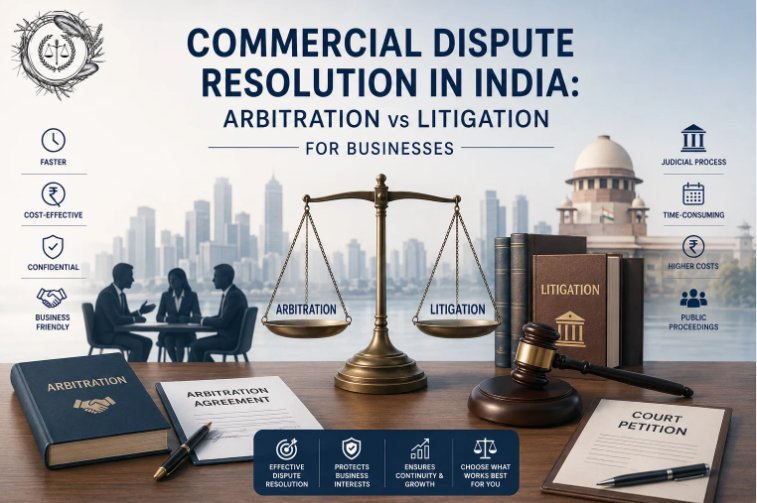
Commercial Dispute Resolution in India: Arbitration vs Litigation for Businesses
Disagreements are a part of doing business. A delayed payment, an unfulfilled contract, or a conflict between business partners can quickly turn into a serious legal issue. When these situations arise, the way a company handles the dispute can affect its finances, reputation, and future business relationships.
In India, businesses have several options for resolving commercial disputes. Two of the most widely used methods are arbitration and litigation. While both provide legal solutions, they differ in terms of procedure, flexibility, costs, and the time involved.
Understanding these differences helps business owners make informed decisions and protect their commercial interests.
What Is Commercial Dispute Resolution?
Commercial dispute resolution is the process of settling disagreements that arise from business transactions, contracts, partnerships, and other commercial activities.
These disputes can involve companies, suppliers, customers, investors, shareholders, or business partners.
Some common commercial disputes in India include:
-
Breach of contract and contractual disagreements
-
Delayed payments and debt recovery
-
Shareholder and partnership conflicts
-
Vendor and supplier disputes
-
Intellectual property disagreements
-
Corporate governance issues
-
Cross-border business disputes
Not every disagreement needs to reach a courtroom. Many disputes can be addressed through negotiation, mediation, or arbitration, depending on the nature of the issue and the willingness of the parties involved.
Choosing the right dispute resolution method can help businesses manage legal expenses, minimise operational disruption, and maintain important commercial relationships.
Commercial Litigation in India: Understanding the Legal Process
Commercial litigation involves resolving business-related disputes through the judicial system. When negotiations fail or a matter requires court intervention, businesses may initiate legal proceedings to protect their rights.
In India, commercial disputes may be heard by Commercial Courts or other courts and tribunals with the appropriate jurisdiction.
Commercial litigation commonly involves:
-
Contract enforcement and breach of contract claims
-
Recovery of outstanding business payments
-
Shareholder and partnership disputes
-
Intellectual property infringement
-
Corporate and financial disagreements
-
Injunctions and other legal remedies
Litigation follows established legal procedures. Both parties present their arguments and supporting evidence before the court, which decides the matter according to applicable law.
Although litigation offers formal legal protection, proceedings may take considerable time, particularly when cases involve complex evidence, multiple hearings, or appeals.
For businesses, the decision to pursue litigation should therefore involve both legal and commercial considerations.
Arbitration vs Litigation in India: Key Differences
Arbitration and litigation serve a similar purpose: resolving disputes through a legally recognised process. However, the way each method works is different.
What Is Arbitration?
Arbitration is a process in which disputing parties refer their disagreement to an independent arbitrator or arbitral tribunal.
In India, arbitration is primarily governed by the Arbitration and Conciliation Act, 1996.
Arbitration generally requires a valid agreement between the parties. This agreement may be included in the original business contract or entered into separately.
The arbitrator examines the evidence and arguments before issuing an arbitral award, which is binding subject to applicable legal provisions.
Businesses often consider arbitration for commercial contracts, construction disputes, shareholder agreements, and international transactions.
What Is Litigation?
Litigation involves presenting a dispute before a court with the authority to hear and decide the matter.
Unlike arbitration, litigation does not generally require the parties to have agreed in advance to use the court system.
It may be appropriate when a dispute cannot legally be referred to arbitration, when no valid arbitration agreement exists, or when specific judicial remedies are required.
Arbitration vs Litigation: Comparison
| Factor | Arbitration | Litigation |
|---|---|---|
| Decision-maker | Arbitrator or arbitral tribunal | Judge or court |
| Procedure | Comparatively flexible | Formal judicial procedure |
| Confidentiality | Generally private, subject to applicable law | Usually public, with exceptions |
| Time | Can be quicker, depending on complexity | May take longer due to court procedures |
| Costs | Arbitrator and legal fees may be substantial | Court fees and legal expenses vary |
| Appeals | Limited grounds for challenging awards | Appeals available where permitted |
| Enforcement | Under applicable arbitration law | Through applicable court procedures |
Neither method is suitable for every situation. The right choice depends on the contract, nature of the dispute, required legal remedies, and business priorities.
Commercial Arbitration Laws in India
The Arbitration and Conciliation Act, 1996 provides the primary legal framework for arbitration proceedings in India.
It addresses domestic arbitration, international commercial arbitration, appointment of arbitrators, interim measures, arbitral awards, and their enforcement.
One important consideration for businesses is the arbitration clause included in commercial agreements.
A properly drafted arbitration clause can clarify how future disagreements will be handled.
It may specify:
-
The disputes covered by arbitration
-
The number and appointment of arbitrators
-
The seat of arbitration
-
The applicable governing law
-
The language and procedure of proceedings
-
The allocation of arbitration costs
Unclear arbitration clauses can lead to disagreements about jurisdiction or procedure before the main dispute is even considered.
Businesses should therefore review dispute resolution clauses carefully when entering into important commercial agreements.
When Should Businesses Choose Arbitration?
Arbitration may be a practical option when businesses want a structured dispute resolution process outside ordinary court proceedings.
It is commonly considered for:
-
High-value commercial agreements
-
Shareholder and joint venture disputes
-
Construction and infrastructure contracts
-
Technology and licensing agreements
-
International business transactions
-
Supplier and service agreements
One advantage of arbitration is the ability to appoint arbitrators with relevant technical or industry knowledge.
It may also provide greater flexibility in scheduling hearings and managing proceedings.
However, arbitration is not always faster or less expensive. Complex cases, multiple hearings, and professional fees can increase the overall cost.
Businesses should assess these factors before choosing arbitration as their preferred dispute resolution method.
Mediation and Alternative Dispute Resolution in India
Not every business conflict requires a binding decision from a court or arbitrator.
Alternative Dispute Resolution (ADR) includes processes such as mediation, conciliation, and arbitration that provide alternatives to conventional court trials.
Mediation can be particularly helpful when businesses want to settle disagreements while maintaining an ongoing commercial relationship.
A mediator acts as a neutral third party and helps both sides explore possible solutions. Unlike an arbitrator, a mediator does not ordinarily impose a decision.
Mediation vs Arbitration
The main difference lies in how the dispute is resolved.
In mediation, the parties work towards a mutually acceptable settlement. In arbitration, the arbitrator makes a decision after considering the arguments and evidence.
Mediation may be suitable when:
-
Both parties are open to negotiation.
-
Maintaining the business relationship is important.
-
Flexible settlement terms are possible.
-
The dispute can be resolved through mutual agreement.
Arbitration may be more appropriate when a binding determination is necessary and the dispute is covered by a valid arbitration agreement.
The choice depends on the circumstances, the parties' objectives, and the available legal options.
Common Commercial Disputes Faced by Indian Businesses
Businesses encounter different kinds of disputes depending on their operations, contractual arrangements, and commercial relationships.
1. Contract Disputes
Contract disputes arise when one party fails to meet agreed obligations or when the parties interpret contractual terms differently.
Common examples include delayed delivery, non-payment, poor service performance, and breach of contractual conditions.
2. Shareholder and Partnership Disputes
Disagreements between shareholders, founders, or partners may involve ownership rights, profit distribution, management decisions, or business control.
Such disputes can affect decision-making and the company's operations.
3. Debt Recovery Disputes
Unpaid invoices and outstanding commercial payments can affect working capital.
Depending on the circumstances, businesses may pursue negotiation, legal notices, arbitration, or appropriate court proceedings to recover outstanding amounts.
4. Insolvency-Related Disputes
Financial difficulties may result in disputes involving creditors, corporate debtors, and insolvency proceedings.
Certain matters fall under the Insolvency and Bankruptcy Code, 2016, and are handled through the relevant legal framework.
5. Cross-Border Commercial Disputes
International transactions may involve disagreements concerning payments, contractual obligations, governing law, or enforcement.
These disputes often require careful consideration of jurisdiction and applicable legal provisions.
Contract Disputes in India: Why Clear Agreements Matter
Many commercial disputes begin with unclear contractual terms.
A business agreement that does not clearly define responsibilities, payment conditions, delivery timelines, or termination rights can create confusion when disagreements arise.
Well-prepared contracts help businesses understand their obligations and available remedies.
Important contractual provisions include:
-
Payment terms and deadlines
-
Responsibilities of each party
-
Termination and notice requirements
-
Liability and indemnity clauses
-
Dispute resolution mechanisms
-
Governing law and jurisdiction
Businesses should also maintain records of agreements, invoices, approvals, and important communications.
Clear documentation can make it easier to establish facts and assess legal rights if a dispute develops.
How Businesses Can Avoid Costly Commercial Litigation
While disputes cannot always be prevented, businesses can take practical steps to reduce legal risks.
Review contracts before signing. Important commercial agreements should clearly explain the rights and obligations of all parties.
Maintain proper documentation. Written communication, payment records, and contractual amendments can become important evidence during a dispute.
Address disagreements early. Delaying action may increase costs and make settlement more difficult.
Consider negotiation and mediation. Early settlement discussions may help resolve disputes without lengthy proceedings.
Seek timely legal guidance. Understanding available remedies and contractual obligations can help businesses avoid unnecessary complications.
Preventive legal planning can be especially valuable for startups and growing businesses that want to minimise disruption and focus on their operations.
How to Choose the Right Commercial Dispute Resolution Strategy
There is no universal solution for every commercial dispute.
Before deciding between arbitration and litigation, businesses should consider several factors.
Nature of the Dispute
Some disagreements are suitable for arbitration, while others require court or tribunal intervention.
Contractual Terms
An existing arbitration clause may determine how an eligible dispute must be resolved.
Time and Cost
Businesses should assess the likely expenses and duration of the available legal processes without assuming that one will always be quicker or cheaper.
Confidentiality
When disputes involve commercially sensitive information, privacy may be an important consideration.
Legal Remedies
The business should determine whether it needs damages, contract enforcement, interim protection, or another form of relief.
Reviewing these factors with legal advisors can help businesses select an appropriate course of action.
How a Commercial Dispute Resolution Lawyer Can Help
Commercial disputes often involve complicated contractual terms, financial records, and legal procedures.
A commercial dispute resolution lawyer can help businesses understand their position and determine which legal options are available.
Legal assistance may include:
-
Reviewing contracts and dispute resolution clauses
-
Assessing potential claims and legal risks
-
Preparing legal notices and documentation
-
Supporting settlement negotiations
-
Advising on mediation and arbitration
-
Representing clients in relevant court or tribunal proceedings
-
Assisting with enforcement and recovery matters
Frequently Asked Questions (FAQs)
1. Is arbitration better than litigation in India?
Arbitration may provide greater procedural flexibility and privacy, while litigation may be necessary for certain disputes or remedies. The better option depends on the circumstances and applicable law.
2. Is arbitration cheaper than litigation?
Not always. Arbitration involves arbitrator fees, legal expenses, and possible institutional charges. The overall cost depends on the complexity and duration of proceedings.
3. Can startups resolve disputes through mediation?
Yes. Mediation can help startups address disagreements involving founders, investors, suppliers, or business partners when the parties are willing to explore settlement.
4. Are arbitration awards legally enforceable in India?
Yes. Arbitral awards are enforceable under applicable provisions of the Arbitration and Conciliation Act, 1996, subject to relevant legal requirements.
5. How long does commercial litigation take in India?
The duration varies depending on the court, complexity of the dispute, evidence, procedural requirements, and possible appeals.
6. Can businesses recover unpaid invoices through legal proceedings?
Yes. Depending on the facts and contractual terms, businesses may pursue negotiation, legal notices, arbitration, or appropriate recovery proceedings.
Conclusion
Commercial disputes can affect more than a company's legal position. They can interrupt operations, strain business relationships, and create financial uncertainty.
Understanding the differences between arbitration and litigation in India allows businesses to approach disagreements with greater clarity.
Arbitration may offer flexibility and a private forum, while litigation provides access to the judicial system and remedies available under law. Mediation and negotiation may also help resolve suitable disputes before formal proceedings become necessary.
Ultimately, the right strategy depends on the dispute, contractual obligations, legal remedies, and commercial priorities.
By maintaining clear agreements, addressing conflicts early, and obtaining appropriate legal advice, businesses can manage commercial disputes more effectively and protect their long-term interests.
Businesses can explore Legalnest's Dispute Resolution and Litigation Services to understand the available legal support.





